
Escalator/Travelator/Moving Walk Truss Components
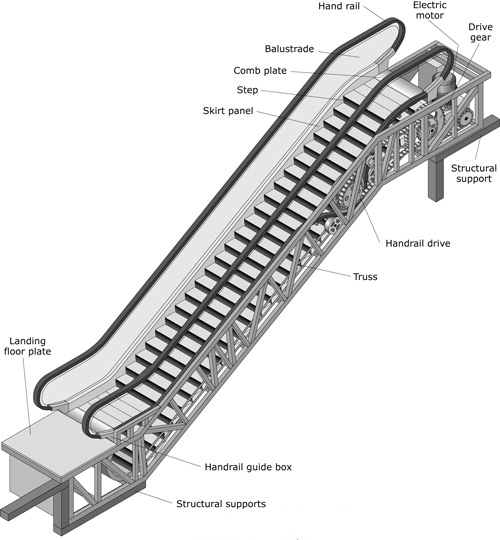
The truss serves as the foundational framework constructed from various steel profiles, housing all the integral machinery. It is segmented into three distinct sections – the upper, middle, and lower sections.

This truss functions as the primary load-bearing structure of the escalator, linking the upper and lower landings. Comprised of two side components connected by cross braces at both the top and bottom, the truss is affixed to the landing platforms with steel or concrete supports. All the straight-track sections that connect the upper and lower modules are carried by the truss. It’s worth noting that escalator areas can accumulate potentially combustible materials such as grease, oil, dust, and fuzz, heightening the risk of fire hazards.
Truss Cleaning
Truss cleaning for escalators/travelators and moving walks involves a meticulous process to ensure the safety and efficient operation of the system. Firstly, the truss components are inspected for any accumulation of dirt, dust, grease, or debris, which can affect the escalator’s performance and pose safety risks. Specialised cleaning equipment, such as brushes, vacuum systems, and cleaning solutions, is then used to remove these contaminants. Regular cleaning not only extends the lifespan of the escalator by preventing the buildup of harmful substances that can affect its mechanical components but also mitigates fire hazards. Truss cleaning is an essential part of escalator maintenance, contributing to both the safety and longevity of these transportation systems
Truss Degreasing
Truss degreasing for an escalator is a specific cleaning process focused on removing grease and oily residues that can accumulate on the structural components of the truss. Grease and oil can find their way onto the truss due to factors like lubrication of moving parts, exposure to environmental contaminants, or even accidental spills.
The degreasing process typically involves the following steps:
- Inspection: Initially, a thorough inspection of the truss is conducted to identify areas with significant grease buildup. This includes examining the cross braces, side sections, and other components of the truss.
- Pre-cleaning: Prior to applying degreasing agents, any loose dirt or debris is removed from the truss using brushes, vacuum systems, or compressed air.
- Degreasing agents: Specialized degreasing agents or solvents are applied to the greasy areas of the truss. These solutions are designed to break down and dissolve the grease, making it easier to remove.
- Scrubbing: A technician may use brushes or scrubbing equipment to agitate the degreasing solution and dislodge the grease from the surfaces of the truss.
- Wiping and rinsing: Once the grease is loosened, it is wiped away with clean cloths or sponges. In some cases, a rinsing step with water may be necessary to ensure that all residues of the degreasing agent are removed.
- Drying: The cleaned truss components are allowed to air dry thoroughly before the escalator is put back into service.
Regular truss degreasing is essential to maintain the safety and efficiency of an escalator. Accumulated grease can not only impede the escalator’s performance but also pose fire hazards, making it imperative to include degreasing as part of routine maintenance procedures.